Email: iads@unilag.edu.ng
Have any question? +234 8020518923

LECTURE BY DR. DIEKARA OLORUNTOBA-OJU
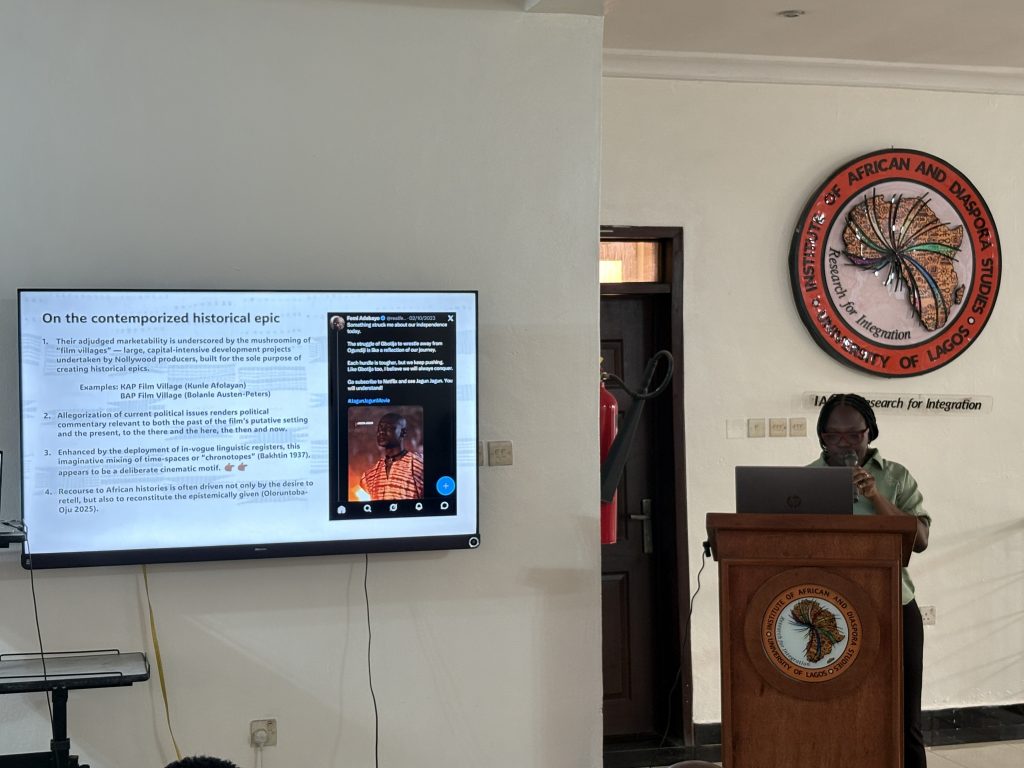
Dr. Diekara Oloruntoba-Oju Tonade, a social anthropologist and a newly appointed Coordinator of the Re:Membering Research Section delivered  a lecture on wednesday, September 30th, 2026.

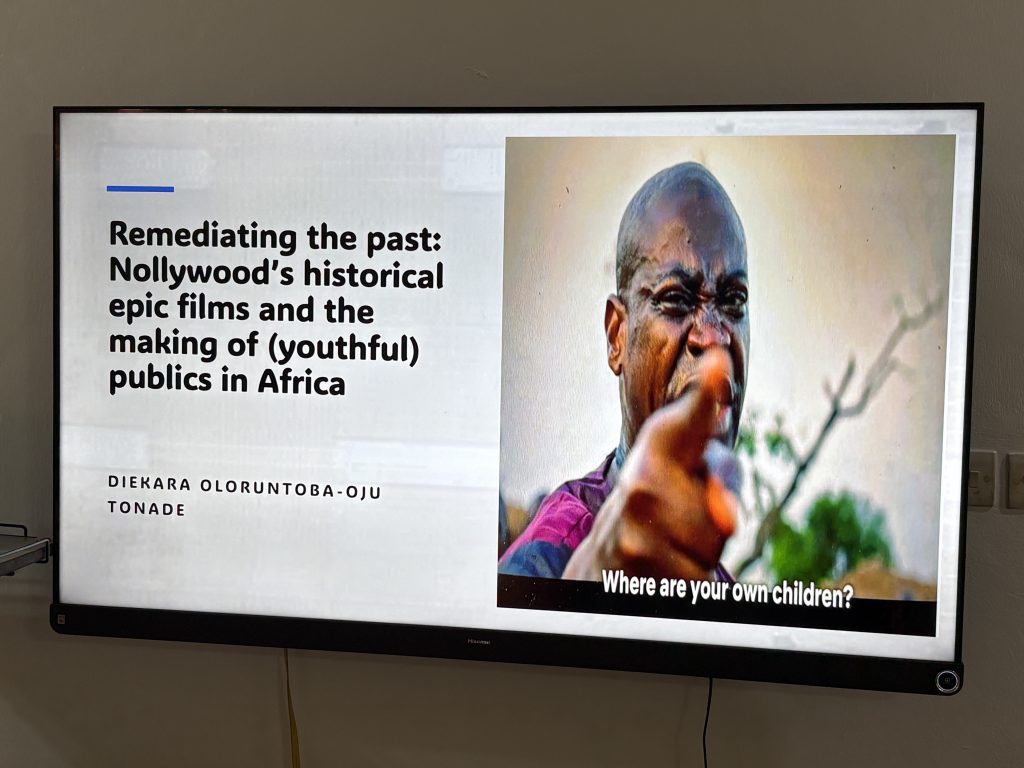
TOPIC: Remediating the Past: Nollywood’s historical epic films and the making of youthful publics in Africa

T-O

The presentation examines how contemporary Nigerian historical films use stories of the past to engage audiences, particularly young Africans, with issues affecting society today.

The presentation identifies the contemporary historical epic as an increasingly popular Nollywood genre. According to the study, these films typically combine African historical settings with modern production technologies, including visual effects, computer-generated imagery and social-media marketing. They also incorporate contemporary linguistic and visual expressions while using historical storylines to address current social issues.

Among the films highlighted are Anikulapo, Jagun Jagun and House of Ga’a, which demonstrate Nollywood’s growing interest in presenting African historical narratives through contemporary cinematic techniques. 

Dr. Diekara Oloruntoba-Oju Tonade explains that filmmakers employ language, gestures, visual techniques and direct forms of address to draw young audiences into the stories. One example highlighted in the presentation is a scene involving the character Gbotija, whose question, “Níbo ni àwọn ọmọ ti yín wà?” (“Where are your own children?”), is directed at a character within the historical setting but can also be understood as a message to contemporary leaders. 
The approach effectively creates a bridge between historical events and today’s political realities, allowing young viewers to see themselves as part of an ongoing conversation about leadership, society and political responsibility.
The presentation concludes that contemporary historical epics are designed to generate political imaginaries that resonate with present-day political conflicts and contribute to the emergence of new forms of political youthful subjectivity. 
 
Further research proposed in the presentation will examine Nigerian film villages and historical film production, as well as corrective theatre practices across Nigeria and Kenya.